
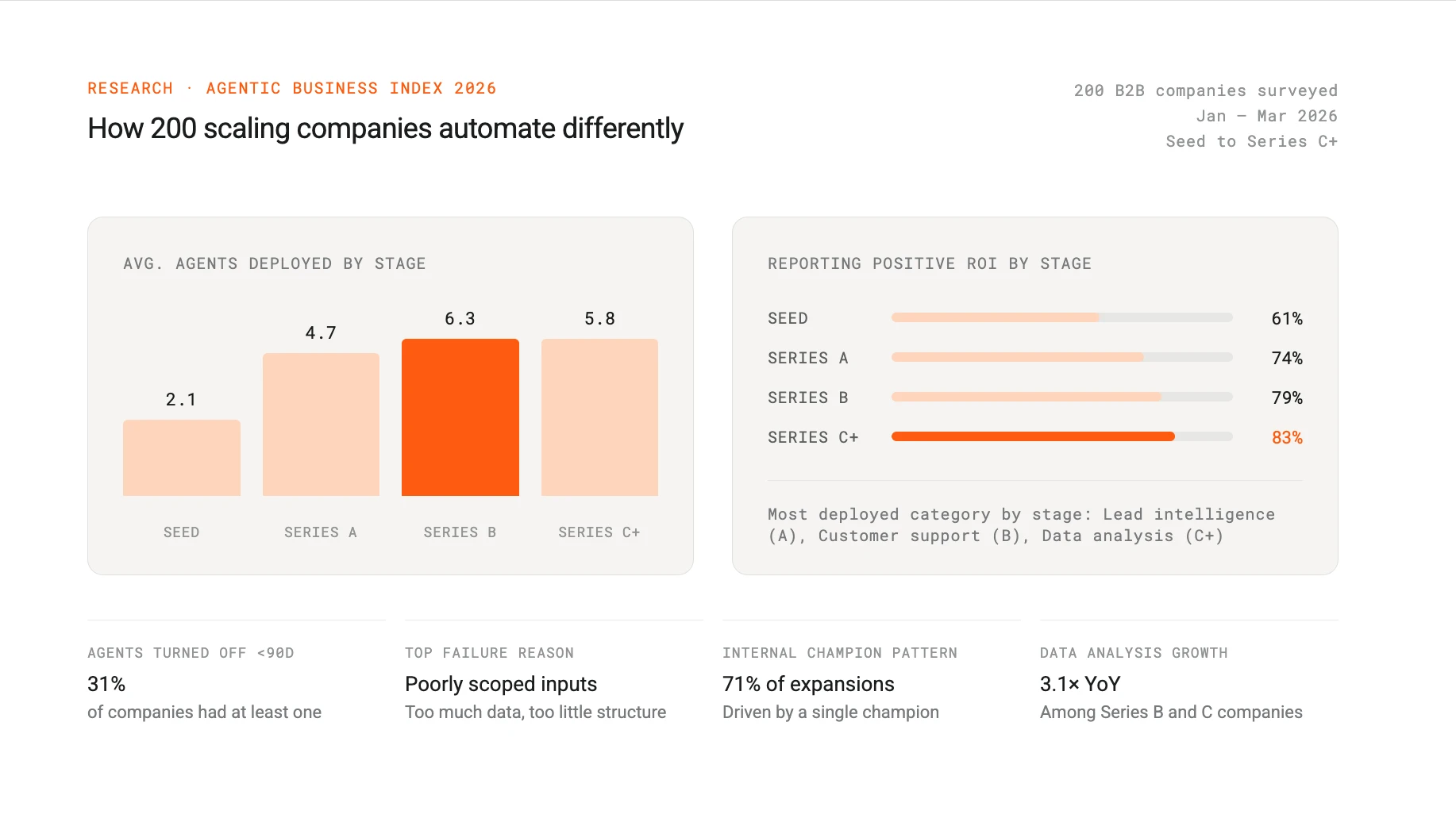
Between January and March 2026, Arty surveyed 200 scaling B2B companies about how they are deploying AI agents, where they are seeing results, and where they are not. Respondents ranged from 20-person seed-stage startups to 800-person Series C companies. All were either Arty customers or had deployed agents through another platform in the previous 12 months.
What we found challenges some widely held assumptions about where agents create value and which teams are leading the charge internally.
The headline finding
Agent adoption is not evenly distributed across company stages. Seed and Series A companies are deploying agents faster and in more categories than their later-stage counterparts. Series C and beyond companies deploy fewer agents per team but report higher average ROI per agent — likely because they take longer to scope and deploy, and therefore deploy fewer but better-targeted ones.
The implication: earlier-stage companies are using agents to punch above their weight. Later-stage companies are using them to protect margins.
Adoption by company stage
Stage | Avg. agents deployed | Most common category | Avg. time to first agent | Reporting positive ROI |
|---|---|---|---|---|
Seed (1–20 employees) | 2.1 | Content operations | 6 days | 61% |
Series A (21–100) | 4.7 | Lead intelligence | 11 days | 74% |
Series B (101–300) | 6.3 | Customer support | 18 days | 79% |
Series C+ (301–800) | 5.8 | Data analysis | 34 days | 83% |
Two things stand out in this table. First, Series B companies deploy the most agents on average — likely because they have enough operational complexity to benefit from automation but still move fast enough to implement it. Second, time to first agent increases sharply at Series C, which correlates with longer procurement cycles and more stakeholders involved in sign-off.
Which agent categories are winning
Lead intelligence and customer support agents account for 58% of all deployments in our sample. That is not surprising — these are the categories with the most measurable outcomes and the clearest handoff between agent and human.
What is more interesting is the growth rate. Data analysis agents have grown 3.1x year over year among Series B and C companies as more teams look to surface insights from internal data without adding analysts. Competitive monitoring — the smallest category overall — has the highest reported satisfaction score at 4.6 out of 5. Teams that deploy it tend to use it daily and describe it as genuinely changing how they track their market.
Where agents are failing
Not every deployment succeeds. 31% of respondents reported at least one agent that was turned off within 90 days. The three most common reasons were:
Poorly scoped inputs. Agents that were given access to too much data with too little structure produced outputs that were hard to act on. The fix in almost every case was narrowing the input source.
No clear owner. Agents without a designated human owner drifted. No one checked the outputs, no one updated the config, and quality degraded quietly.
Wrong category for the problem. Several respondents tried to use content operations agents for tasks that were better suited to onboarding automation. Category fit matters.
The internal champion pattern
In 71% of companies that had successfully expanded their agent deployment beyond two agents, the expansion was driven by a single internal champion — typically a head of operations, a growth lead, or a technically capable founder. The pattern is consistent: one person demonstrates value in one use case, then pulls the rest of the organisation forward.
This has a direct implication for how vendors should think about onboarding. The first deployment is not just a product decision. It is a political one. Make it easy for the champion to show a win quickly.
What we will track next
This is the first edition of the Agentic Business Index. We will run it twice a year. The areas we are most interested in for the next edition are agent failure rates over time, the relationship between agent ownership structures and retention, and how enterprise procurement cycles are evolving as agents move from experiment to infrastructure.
If you are interested in participating in the next wave of research, the sign-up is at the bottom of this page.