



Every few years, a new way of organising a business emerges. First it was the internet company. Then the data-driven company. Then the product-led company. Each shift wasn't just about new tools — it was about rethinking what the business is capable of and how it operates at its core.
We're at the beginning of the next shift. The agentic business.
What makes a business agentic?
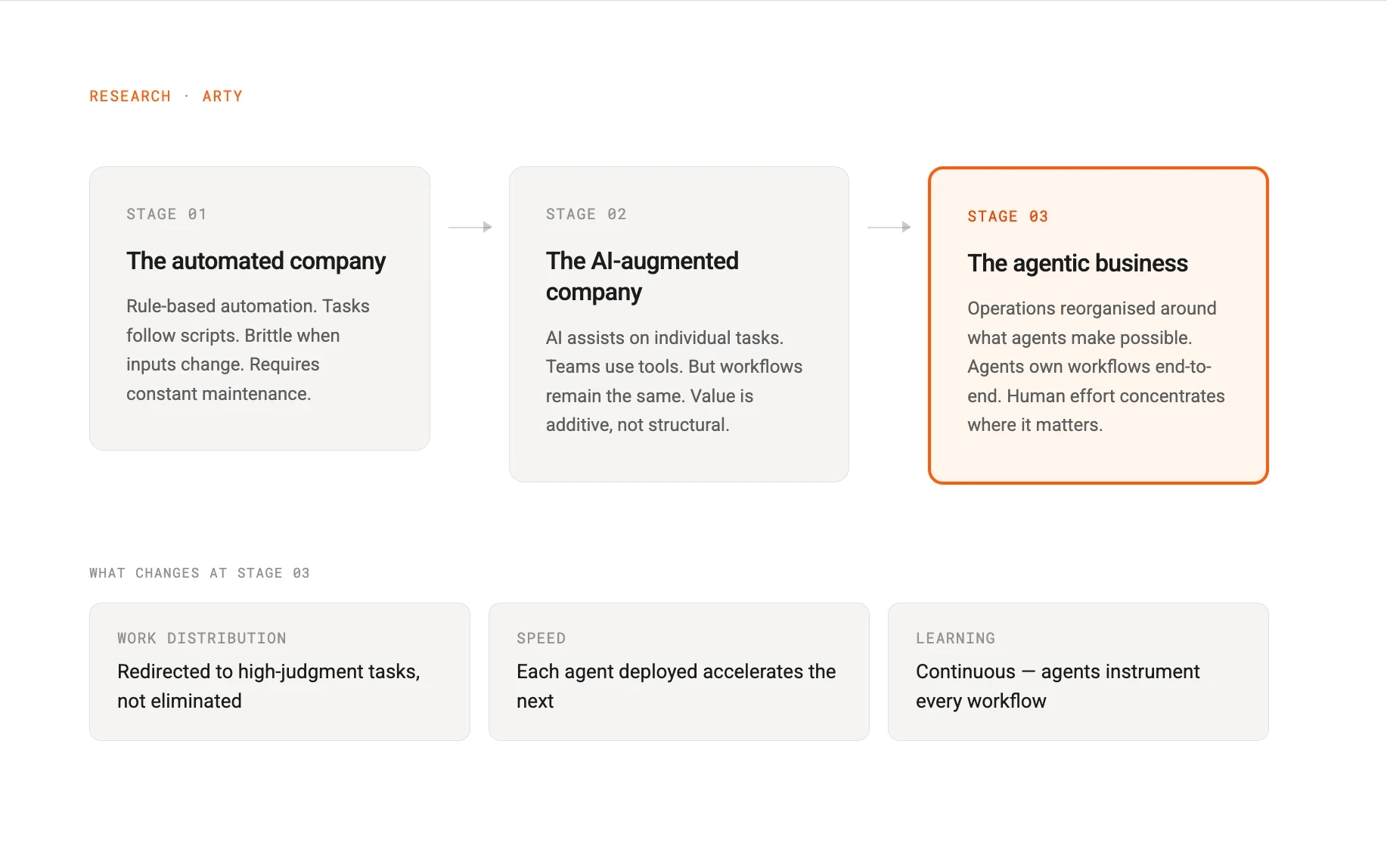
An agentic business is one that has reorganised its operations around what AI agents make possible — not bolted agents onto existing workflows, but fundamentally rethought how work gets done.
The distinction matters. Most companies experimenting with AI today are doing the former. They find a task, automate it, and move on. The workflow is the same. The people are the same. The only thing that changed is one step now has a bot doing it.
An agentic business asks a different question: if agents can handle entire workflows end-to-end, what should our team actually be doing? That question leads somewhere much more interesting.
Agents vs. automation
It's worth separating agents from the automation that came before them. Traditional automation — RPA, Zapier, simple scripts — is brittle and rule-based. It does exactly what you tell it to, nothing more. Change the input format, and it breaks. Add a new edge case, and someone has to update the rules.
Agents are fundamentally different. They reason over inputs, take sequences of actions, make decisions based on context, and adapt when things don't go as expected. A support agent doesn't just route tickets — it reads the ticket, checks the customer's history, searches the knowledge base, drafts a response, and escalates only when the situation genuinely requires a human. The difference between that and a routing rule is the difference between a calculator and a colleague.
This is what makes the agentic business possible. Automation could reduce effort on a task. Agents can own a workflow.
What changes when you become agentic?
Three things shift when a business moves from experimenting with AI to operating agentically.
Work gets redistributed, not eliminated. The teams that adopt agents fastest don't shrink — they redirect. A support team that deployed an agent to handle tier-1 queries didn't cut headcount. They moved their people onto the complex, high-value issues that actually require human judgment. The same volume of work gets done, but the human contribution is concentrated where it counts.
Speed compounds. Each agent you deploy accelerates the next one. Your CRM is cleaner because a lead intelligence agent keeps it updated, so your outreach agent has better data, so your conversion rates improve, so your onboarding agent handles more customers, so your support agent gets more cases it already has context for. The value doesn't add — it multiplies.
The business learns continuously. Agents generate data about how workflows actually run — where delays occur, which decisions get escalated, what inputs produce what outputs. Agentic businesses instrument their operations in a way that wasn't possible before. That data becomes the raw material for the next improvement cycle.
The two paths in
There's no single way to become an agentic business, but two patterns emerge consistently.
The first is the done-for-you path. A business identifies a high-friction workflow — lead qualification, support triage, onboarding sequences — and works with an agent platform to scope and deploy a custom agent. This path is fast. The first agent is typically live within two weeks and starts generating measurable output immediately. It's the right starting point for business teams who want results without an engineering project.
The second is the build-your-own path. A technical team forks a production-ready agent from a library, extends it to fit their specific workflow, and integrates it into their product or internal tooling via API. This path offers more control and tends to go deeper into core business logic. It's the right starting point for teams who want agents embedded in how their product works, not just how their operations run.
The businesses that move fastest typically start with the first path to get early wins, then shift to the second path to build the infrastructure that scales.
Why now?
The honest answer is that agents became reliable enough to trust with real workflows in the last 18 months. The underlying models improved dramatically. The tooling to deploy, monitor, and update agents matured. And enough early adopters ran enough real experiments to produce a body of evidence about what works.
The window between "early adopter" and "table stakes" in enterprise software has historically been three to five years. The businesses that move in the first year tend to build compounding advantages that are hard to close later — not because they have better technology, but because they have more data, more refined workflows, and teams that have learned how to work alongside agents effectively.
The agentic business isn't a prediction about the future. It's a description of what the fastest-moving companies are already building right now.
Where to start
If you're evaluating whether your business is ready to make this shift, the most useful question isn't "which task should we automate?" It's "which workflow, if an agent owned it end-to-end, would change what our team is capable of?"
Start there. Pick one workflow. Deploy one agent. Measure what changes. The compounding starts with the first one.